Episode 13: How do I make a resume?

Resume writing is a skill that everyone seems to have an opinion on - from schools and universities that create specific resume writing guidelines for their graduates, to career advisors and even parents who can provide specific resume advice. We’ve combined some of the best resume advice out there into this short guide to get you started on writing your first resume.
Let’s start with what a resume actually is. Your resume is a one-page summary of your entire professional history, your skills and all of the market value you have as a person. Think of it as an advertisement for yourself, where you hand someone a 1-page sheet summarizing why they should give you a job. They are giving you money to do something, whatever that something is, and your job is to prove to them that they’re not wasting that money on you.
That's also the mindset you should have when going into your resume-writing. If you were a hiring manager, what would you actually want to see from a candidate? Would you want a resume with lots of fillers, not enough experiences, or no skills? Would you want a specific style of resume? Realistically, for many job positions that are applied to by thousands of people every year, hiring managers have to make some decisions based on what's on your page.
Now, you’re probably more qualified than you think you are, and you can probably find a list of skills online and start saying “yeah, I can do that”, but most recruiters want to see proof that you can do what you’re saying you can - where those skills actually come from. That’s where the whole “education, experiences, volunteering” spiel comes from, as recruiters want to know what actual experiences you’ve had that you use to back up your claims about who you are and what you can do.
That means that you have to tailor that one page for the specific job description you're applying for or pursuing. You need to summarize all the proof you have that you'd be good for that specific job into a page. Start like this -
Go to the job description you’re looking at, and look at the skills and qualities they want to see from applicants
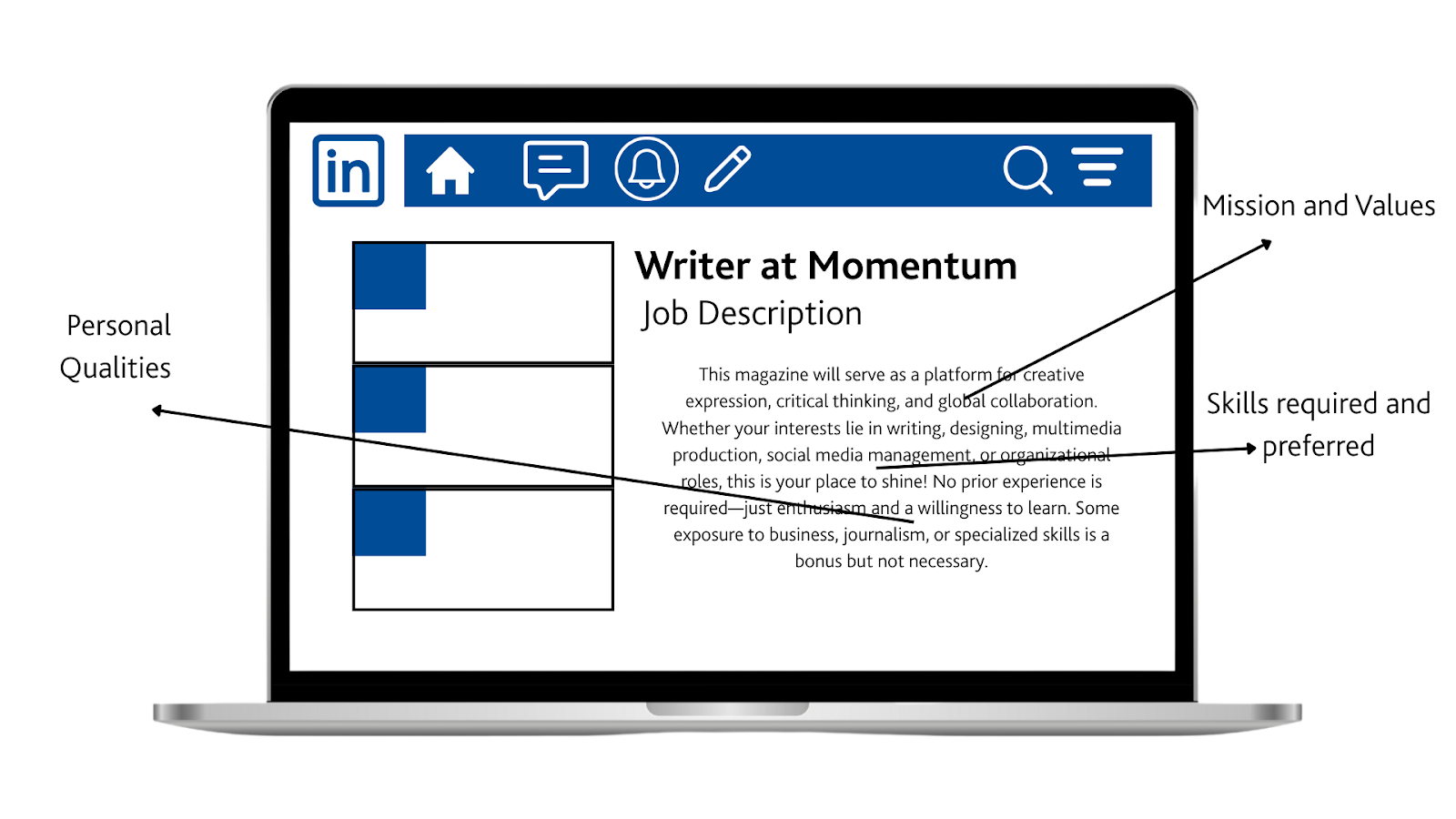
List all that apply to you at the very beginning of your resume, under a section titled “skills and qualities”. For example, if they are looking for "media management" experience, or the job says it requires "collaboration" skills, just make a list at the top of your resume of those skills. This isn't just to make sure that you're using the language of the business, but also because of one very important transformation in the recruiting process - the use of AI screening for resumes.
If you have a computer and a working email, chances are that you've - at some point - used ChatGPT, or a different AI model at least once. These Artificial Intelligence models can use past data about things to make predictions for future data. For example, if you ask ChatGPT to name the best restaurant in your town, it might use previous data, like Google ratings or online reviews, aggregate them all, and then provide you with what it predicts would be considered to be the best restaurant in the area.
That's a process that companies - especially the ones that receive thousands of applications every single month - are now using to decide who they hire. AI recruiting models, or bots, are essentially fed the resumes of thousands (if not more) successful candidates, and they use that data to then screen your resume and decide whether or not to hire you. As a result, everything from the formatting of your resume, to the wording you use, has to be able to pass an AI resume screening.

That's why we use the language of the actual job description - since it will be the information that the Chat model will actually be searching for. The most important language to replicate is the specific skills that the company is looking for - most companies will screen resumes on whether the skills they want to see are present.
Once you've listed all the skills, think of an experience or educational credential you have that actually displays them. For example, if you’re applying for a paid tutoring position, and the job description asks for communication skills, you might talk about your experiences as a peer tutor in school. You could also talk about any workshops you’ve done looking at education skills, or even a high school/college subject or course - like psychology - that you scored highly on in writing. Your “subheadings” on your resume will essentially be the types of credentials you can show. Some possible subheadings include:
- Your educational history, especially if they require degrees
- Any awards or recognition you’ve gotten for your work, as long as it’s relevant to what you’re applying to
- Any certificates or special qualifications you have that are relevant to what you want to do
- A club or extracurricular activity where you honed relevant skills
- A volunteer experience either in an initiative you started or participated in
- A research project or program you completed where you actually did work relevant to the industry you're applying to
The most important thing you can add to your resume is previous work experience - whether that's as an internship, or part-time work, or even a full-time job. Try to do your best to accumulate some form of previous work experience before you apply to a full-blown job. This is less important if you're applying for your first internship, for example. Some guidance on how to do this can be found in Episode 12!
As you move into university, you want to accumulate as much work, volunteer and research experience, which demonstrates your skills and abilities on the job. If you want to do things worth writing about on a resume, make sure that you're always looking for opportunities and trying to engage in some of the activities listed above, with internships and previous work experience on top, so that you have something to write about on your resume.

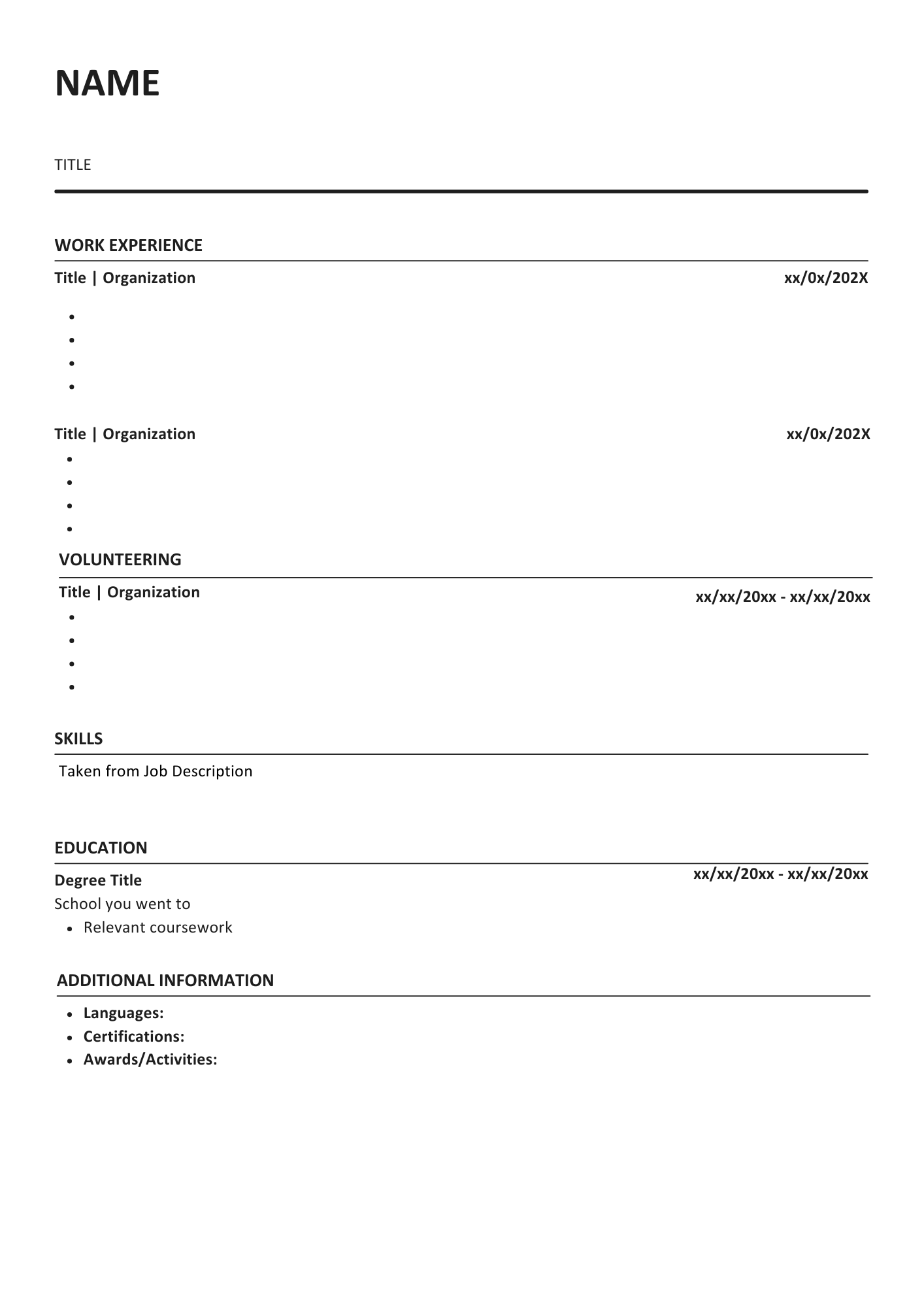
Once you’ve listed your previous work experiences and decided on subheadings, you can start by creating or customizing your resume template with those subheadings. There are many resume templates out there, but it's important to remember the audience of your resume - an Applicant Tracking System (ATS). Among thousands of applicants, you're not going to be in a paper stack - instead, you'll be a digital byte, and your information will be extracted in chunks so a hiring manager can browse it. As such, style doesn't matter as much for your resume as clarity. Sometimes, just going with black & white, with Arial or Calibri as your font. The key is consistency - remember to use one font, one size, and one color throughout for everything.
On your page, each subheading will be a title on a block - which is just a segment of your page. Resume blocks should be formatted in the same way. Think of having a maximum of two columns, each highlighting something different. You can also just format everything in a continuous stream.
Under each block, list the experiences you came up with in reverse chronological order, including the job/position title, the company or organization you worked with/were at, and the duration you were there for. There! Now you have a pretty clear template that might look something like this:
Once you have your template ready, that’s when you start maxxing up each experience by adding a description that shows why you're an impressive candidate for your role. Here's how to write a strong description:
- Start with the what - use a single bullet point to explain what you did in that role - were you washing dishes? Were you taking out somebody’s trash? Were you filming tiktoks? Were you making spreadsheets?
- Then, move on to the result - what did you actually achieve by doing that? There, you want to use numbers to show that you’re impressive - if you made 100 tiktoks in a month, or one got 50,000 views, that is really impressive and completely worth mentioning!
- Lastly, add the how - what skills did you develop or use through the experience? This is where you’re dropping as many buzzwords as possible
Then, format in the last few details - the organization your experience was at and the duration of the experience. Make sure to keep your formatting consistent!
When you’re doing this, try to ensure that your bullet points are as concise and clear as possible - remember, somebody’s going to be scanning through that document in the span of a minute, so a one-page (maximum two-page) resume is all that they want to see. They want to know exactly what makes you fit for the job that they need somebody to do, and they are looking for very specific things. Often, those things are already in the job description. Make sure that you’ve covered all of your bases by ensuring that all of the job description keywords show up at least once on your resume. Also make sure that you’re summarizing everything in a maximum of six lines per experience, and that you’re not going over one page in total.
Other than skills and experiences, you might also want to go back to beef up your “education” section by including the institution you went to, the courses you took, the best grades you got, and any other relevant information for your industry (don’t know? Ask Google.)
Once you’re done with that first draft, go back and make sure that the tone is something that you’d actually want recruiters to be reading. Here’s a quick checklist to get you started:
- Have I used an active voice? - an active voice means that you’re using action verbs, and are cutting out any filler words. For example: “I have engaged in the creation of a new software” can become “Created new software…” , where we essentially transformed the noun “creation” into the verb “created”. In that way, it feels more like you were actively engaged, plus it’s a lot clearer.
- Have I formatted in a readable way? - The easiest way to do that is to check with someone else. Find a friend, parent or trusted person and get them to read your resume in a minute, then ask if there were some redundant, weirdly worded or just unreadable parts. None? Then off you go! Plus, make sure that you’re using a clean font, and clearly mark out sections with dividers
- Have I listed in reverse chronological order? - All your recent experiences should go on first, and then you can start going back in time - so order your experiences within sections chronologically from recent-first
- Have I used “third-person address?” - you want to make sure that there are 0 pronouns anywhere. There should be no “I’s” or “me’s”. In fact, many colleges and career advisors recommend not having a picture in your resume! Remember, a recruiter isn’t actually trying to get to know you, they just want to assess whether you’re the right fit for them. Writing in a third-person voice, which basically means writing like an NPC actually helps get your message across.
If you’ve gotten this far, you’ve probably got a successful resume under your belt! You can now send this one-page document to the specific job position you want.
If this sounds time-consuming, it’s because it is! To make your life easier, consider creating a resume database - a doc or note where you pre-write your experiences with bullet points and do all the heavy lifting for your writing so that you can copy-paste each block or experience back into your resume. To make one, just use this guide, but for all relevant experiences you've ever had instead. Keep them all in a Google Doc or similar notes page, so you can just copy-paste them back into a template if you need. EZ!