Episode 11: How Do I Know What The Right Job for Me Is?

Nothing beats scrolling through TikTok at 1 a.m., and switching between memes, career quizzes, and conspiracy theories, all before you’ve even gotten out of bed. Maybe you see that video of a sped-up capybara dancing and think: what if I became a zoologist? The next minute, you’re convinced you should become a marine biologist, then a lawyer, then maybe open a coffee shop in Italy. Choosing a career as a teenager is a lot like that: exciting, chaotic, and fueled by an algorithm that has no idea who you really are. Social media makes every job look fun in a 30-second clip, but a career is more than “day in the life” content. It’s meetings, deadlines, interviews, indecision and a lot of self-searching.
You’re probably receiving lots of advice from the people around you on how to choose that perfect career. Your career is the thing you’ll dedicate between 80,000 to 90,000 hours of your life on, so the choice is heavy! Whether you’re coming from a “doctor/lawyer/failure” family or “do what makes you happy” family, one thing you’ll hear a lot is the “secret” to a perfect career choice: a single factor that determines the success of your future career.
To some people, that factor is passion and genuine enjoyment. It's important to distinguish a genuine passion from “whatever is fun in the moment”, because watching Netflix is fun, but no one’s paying you to binge TV (well, almost no one). To distinguish a passion from a passing interest, ask yourself how it makes you feel in the long-term. Watching Netflix is fun, but watching it for hours on end might make you feel bored or fed-up. Eventually, you might run out of stuff to watch! A true passion is an activity that energizes you and fuels your curiosity, keeping you active without feeling fatigued. Try and observe what consistently pulls your attention, even when it's challenging. In class, you might not love writing essays in English, but you could enjoy researching, debating or analyzing ideas. You can find passion in classes you don’t dread, hobbies you get absorbed in, or volunteer projects you wish lasted longer. Trying different roles lets you see what keeps you engaged beyond the initial novelty. If you can work on a passion and still deeply enjoy it, that's a genuine passion.
But what happens if we choose a career solely out of passion? You've probably heard the horror stories from concerned family friends, talking about starving artists who never really got anywhere in life because they just did something they were passionate about. Let's widen our horizons and consider some other pathways.

For others, especially our activists, their values are what gets them going. A value can be understood as a fundamental belief or standard that shapes how you view the world and makes decisions. Your values could be anything from empathy towards others or excellence in everything you do. Just search a list of "core values" online to find hundreds of descriptors. If you identify the key values you have, and the issues you associate with them, you can find the kinds of careers or causes that will feel meaningful and sustainable in the long term.
You might stop at ‘I want to help people’ or ‘I want to make money,’ but values go deeper: it's the way you want to live. For some, it could be stability, never worrying about finances and avoiding risky job placements. For others, having the ability to be creative at your job, as people often prioritize having independence to work on their own time and in their own organizations. i If you ignore your values, you could land a job that looks like your dream but leaves you drained. Let's look at Natalie, who chose engineering because she loved building and problem-solving, but heavily values financial stability. While she doesn’t enjoy every meeting or report she has to write, her career still feels rewarding because it aligns with what matters most to her– financial security and the chance to solve complex problems. This shows that passion alone isn’t enough; your values help determine whether a career is sustainable for you in the long run. To figure out your own values, it can help to reflect on past experiences that made you feel fulfilled and notice what trade-offs you’re willing to make.

Since values also often connect to legacy, it’s important to consider how you want legacy. The choices you make transcend your personal happiness, they also shape the kind of mark you leave on others and the world. Ravi, a teacher, does his work not to make an income, but to ensure that future generations are educated. Thinking about legacy means asking not only ‘What do I want for myself?’ but also ‘What does the world need, and how can my values help meet that need?’ When your values align with a broader purpose, your work becomes more than a career and closer to something that will outlive you.
Of course, some people will argue that the most important factor in choosing a career is money. Yet, the amount of money you may need is highly variable, depending on your financial goals and priorities. For instance, Ravi’s teacher salary might be around $45,000, while a starting software engineer could earn closer to $80,000. Over a decade, that difference amounts to $350,000 or more. Yet the key consideration is the lifestyle you intend to build. Ravi, as a teacher, structures his budget carefully, prioritizing stability and meaningful experiences with the students he teaches. However, he must secede financial comfort, and accept a simpler standard of living in exchange for fulfillment and impact. Natalie, as an engineer has greater financial flexibility– that means she can save more money, and do things like travel and shop more comfortably. She still finds purpose, because her career as an engineer reflects both her interests and her value of stability. In both cases, their paths are sustainable, but they have to align their job choices with their personal values and long term goals.
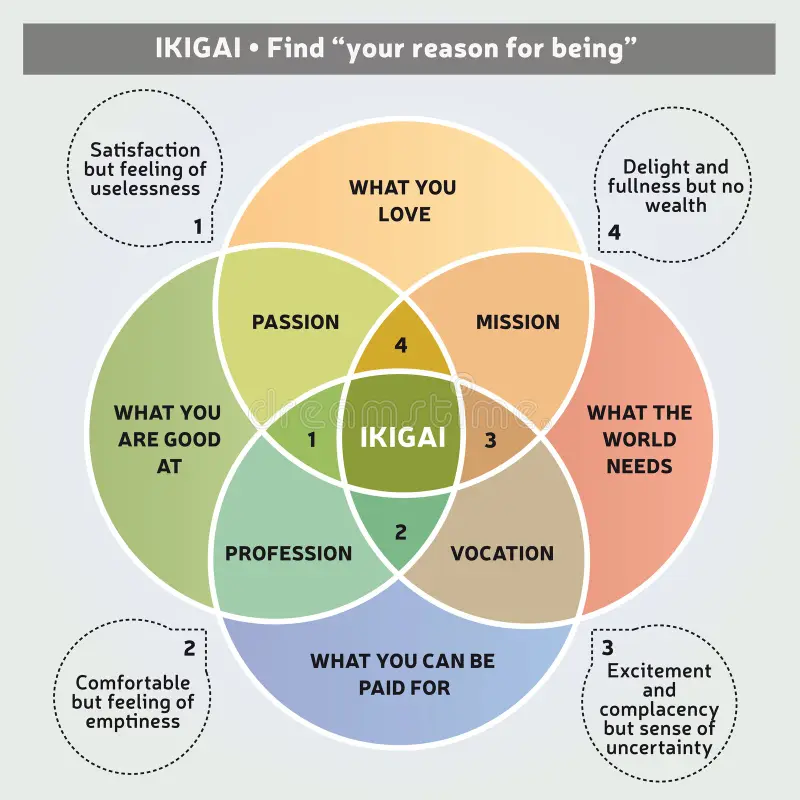
One way to bring all these ideas together is through Ikigai, a Japanese concept meaning “reason for being.” Imagine four overlapping circles: what you love, what you’re good at, what the world needs, and what you can be paid for. The overlap in the middle is your Ikigai. It’s not about finding the one perfect job that checks every box—it’s about aiming for a balance. If your dream checks two circles but not all four, you’ll start to feel it. A job you love but that doesn’t pay might leave you broke, while one that pays well but drains you can lead to burnout. The real goal isn’t to maximize one factor but to integrate all four: what you love, what you’re good at, what the world needs, and what you can be paid for. No single area is more important than the others. It’s their balance that can give you a fulfilling career. As an example, Natalie blends her love of problem-solving with her strength in engineering, while also meeting the world’s need for innovation and securing financial stability. It’s this kind of integration that makes her career successful and purposeful long-term.
Even when you have a values or purpose-aligned career, it's important to consider other key factors like the education you'll need to enter the career, the financial viability of pursuing the career you envisage, and just the lifestyle considerations of how much time and energy you want to invest into your work throughout your life.
Your willingness to spend time learning is important. It’s not just how many years you’re willing to spend in school—it’s about what you get in return. Medicine, for example, pays well, but the decade of schooling and training is brutal. A trade job or a tech bootcamp might get you earning in two years, but you’ll need to keep re-learning as technology changes. Think of education like an investment: the time and money you put in should realistically connect to the opportunities you want later.
Lastly, try to envision lifestyle. Do you picture yourself in a 9-to-5 office, or do you want variety, travel or flexibility? The environment shapes your day-to-day happiness too. Natalie, an engineer and startup runner might thrive on the thrill of constant networking and big presentations, while Ravi, a teacher, values the rhythm of the school year. Neither is “better”, but knowing what environment you’d be happy in prevents you from feeling trapped later. One way to start figuring this out is by identifying your strengths. A simple framework is the “praise test’. Consider what people consistently compliment you on, whether it's explaining tough concepts in class, staying calm under pressure, or coming up with creative ideas. These patterns can reveal skills you might overlook in yourself and help you connect your strengths to a career environment you could thrive in.

The financial side is another layer you can’t ignore. Some careers require expensive degrees, which means loans. Talking openly with your parents about budgets, aid, and repayment plans helps you avoid surprises. A $200,000 law degree might pay off if you’re committed to that path, but a $200,000 art degree with limited job prospects could weigh you down for decades. Sometimes the smartest move is a community college or state school, especially if it frees up resources for internships and experience. Sometimes the expensive school is worth it for connections and long-term payoffs. It comes down to what you think will support you best.
The most important thing to do when figuring out what career path you want is career exploration. These are activities you can do before starting on a career that help you better understand what it is, what you do, and how to get there. Then, based on your exploration activities, you can decide which career path is the most suitable for you. Here are some ways you can explore careers:
- Organize a coffee chat (an informal conversation or interview) with a career professional - you can connect with alumni of your school or university, scout someone online working at a company you're interested in, or even just ask around in your community
- Write to a company or a professional to shadow or follow them around for a day to experience what their career is like. You can also do this for colleges!
- Engage in a volunteering experience in a field related to your future career - for example, if you're interested in human rights law, you could actually volunteer with a local human rights institute
- Complete an internship - a short-term work experience program where you essentially do a job for a short period of time (typically two weeks), and experience that job on your own

Finding these opportunities starts with your network, but network doesn’t just mean business cards and formal events. It can include teachers who know your academic strengths, coaches who can vouch for your work ethic, club advisors who see your leadership, or even friends parents who work in interesting fields. Each method can be used and found in a different way. As simple as asking a teacher for advice on summer programs, reaching out to alumni on platforms like LinkedIn, or simply starting a conversation with a family friend about their job. And if your existing network feels limited, you can go beyond it. Cold outreach is often powerful. Sometimes, a cold-email can get you in meetings, conversations and interactions you wouldn't even imagine!
If you'd like to reach out to someone within your network, try using this cold-email format:
- Start off with a formal greeting explaining who you are
- Mention that you’re a student/young person, highlighting your current educational background and your interest in their field
- Explain how you found out about them, and what you admire about them, their company or their work - always do your research beforehand and try to be very specific
- Then, explain what you want from them - do you want to job-shadow? Do you want to simply chat?
- When that’s complete, give your availabilities for your request!
The key skills here are preparation and specificity, as networking helps you build relationships and learn.
The truth is, there’s no single perfect choice waiting for you, no one job that magically checks every box. The path looks more like testing, adjusting, and learning, not locking in a single decision at 17. Natalie didn’t know for sure engineering was her forever career when she started. Ravi didn’t expect teaching to feel fulfilling until he tried it. Brandon may still be figuring out if the Porsche is worth the grind. But at the end of the day, your career is completely your choice - and we want you to make an informed one.